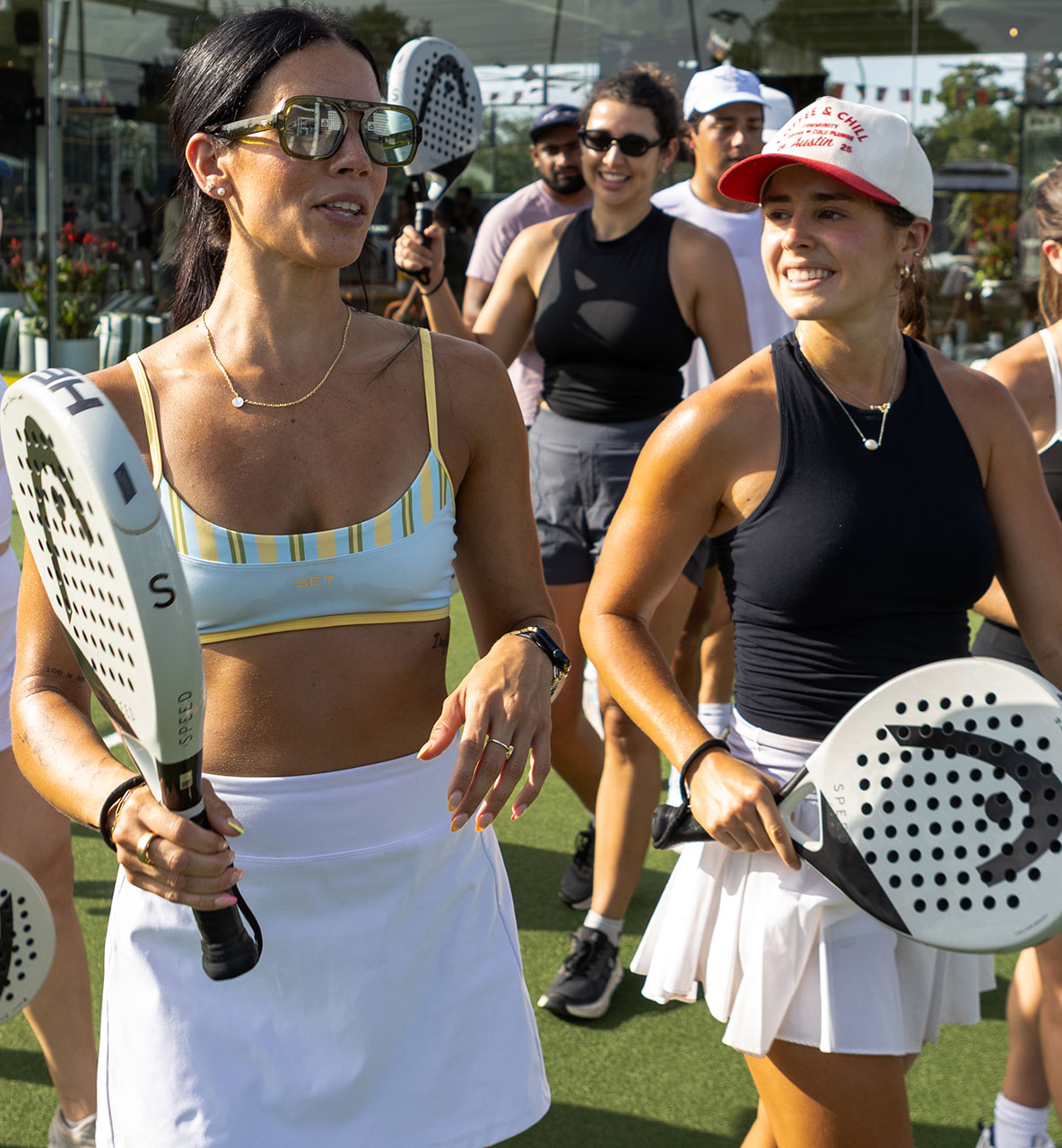
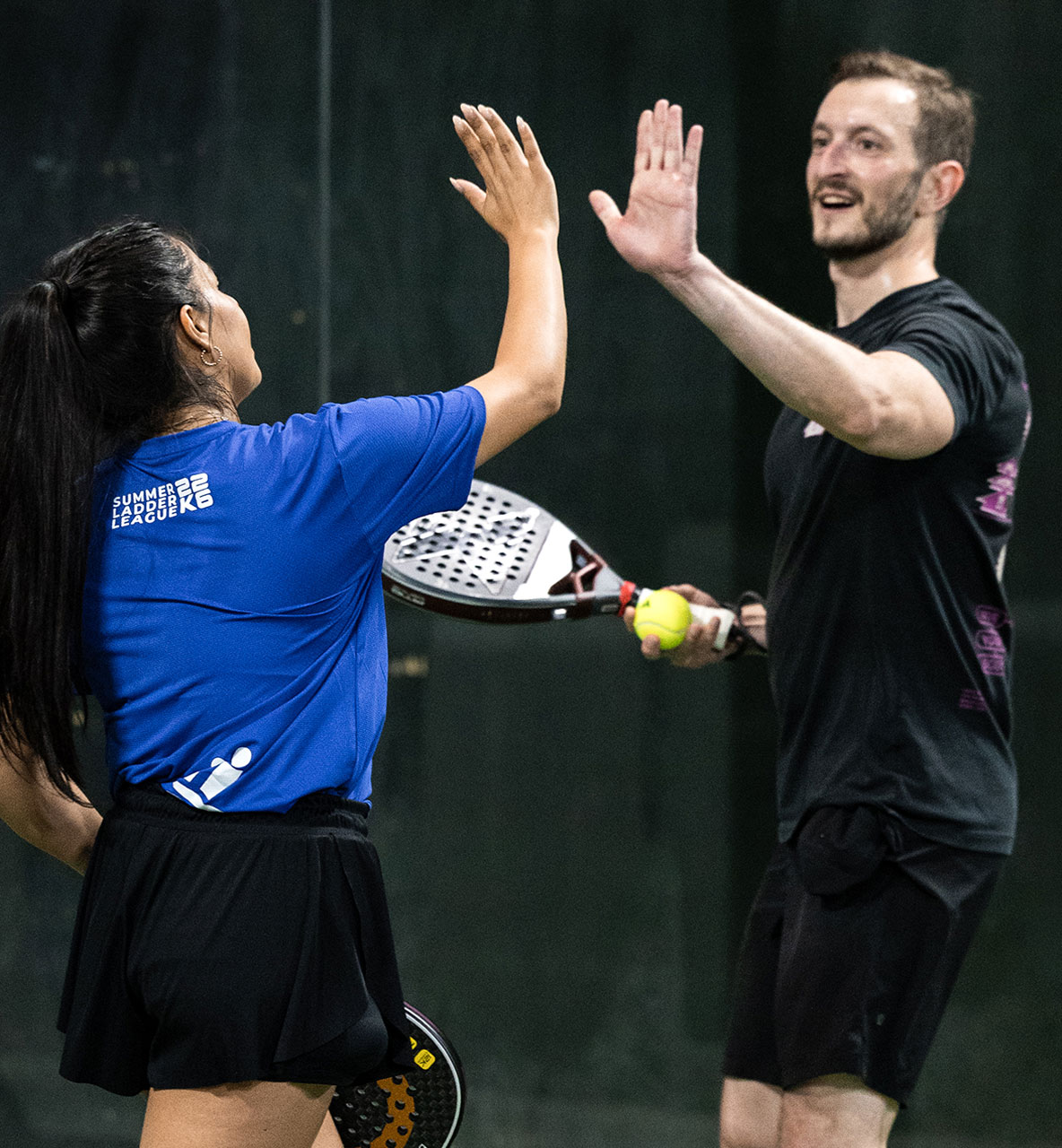
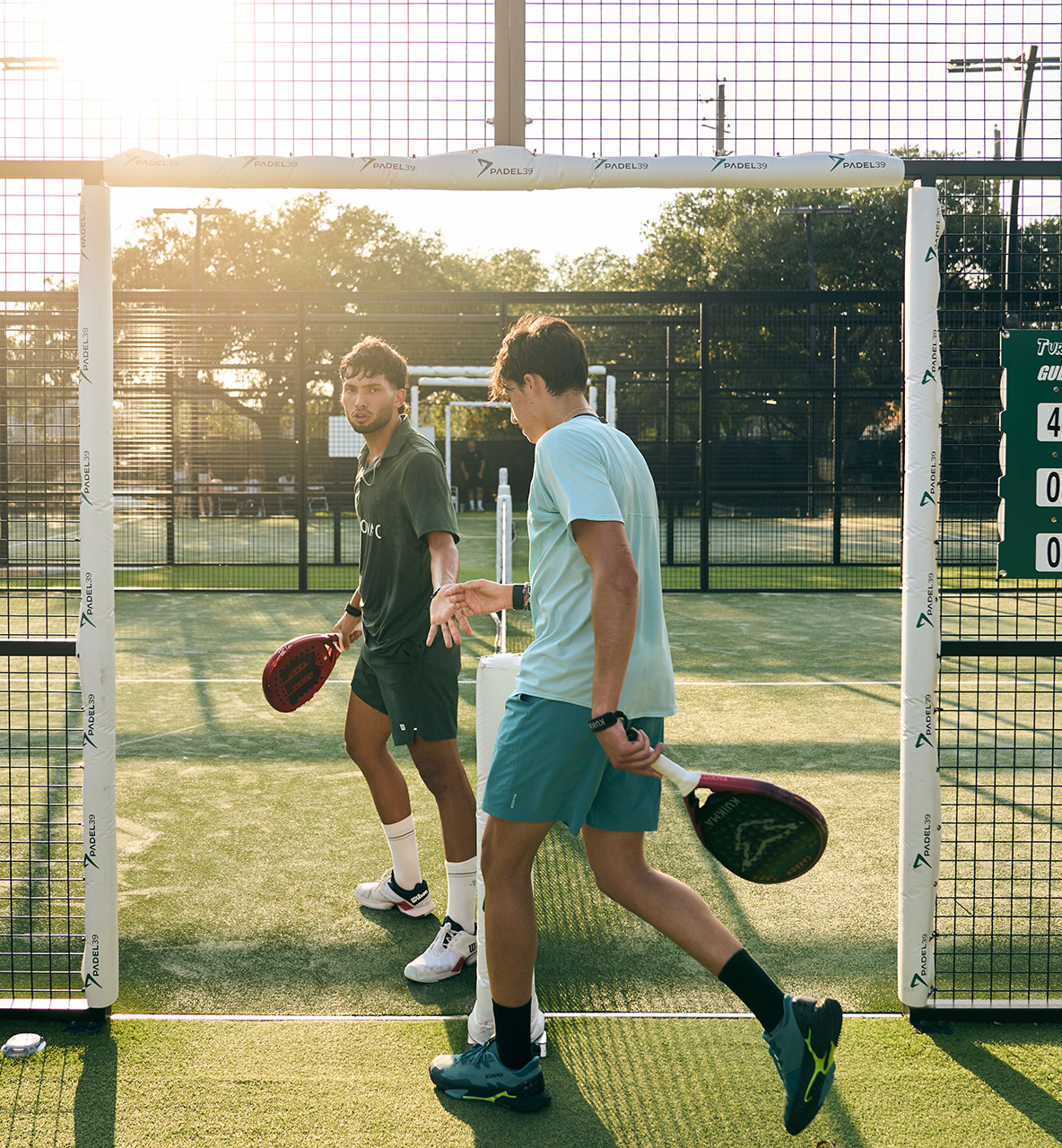
Free Intros. Weekly free intros to padel at East Austin, North Austin, and North Dallas. Sign up.


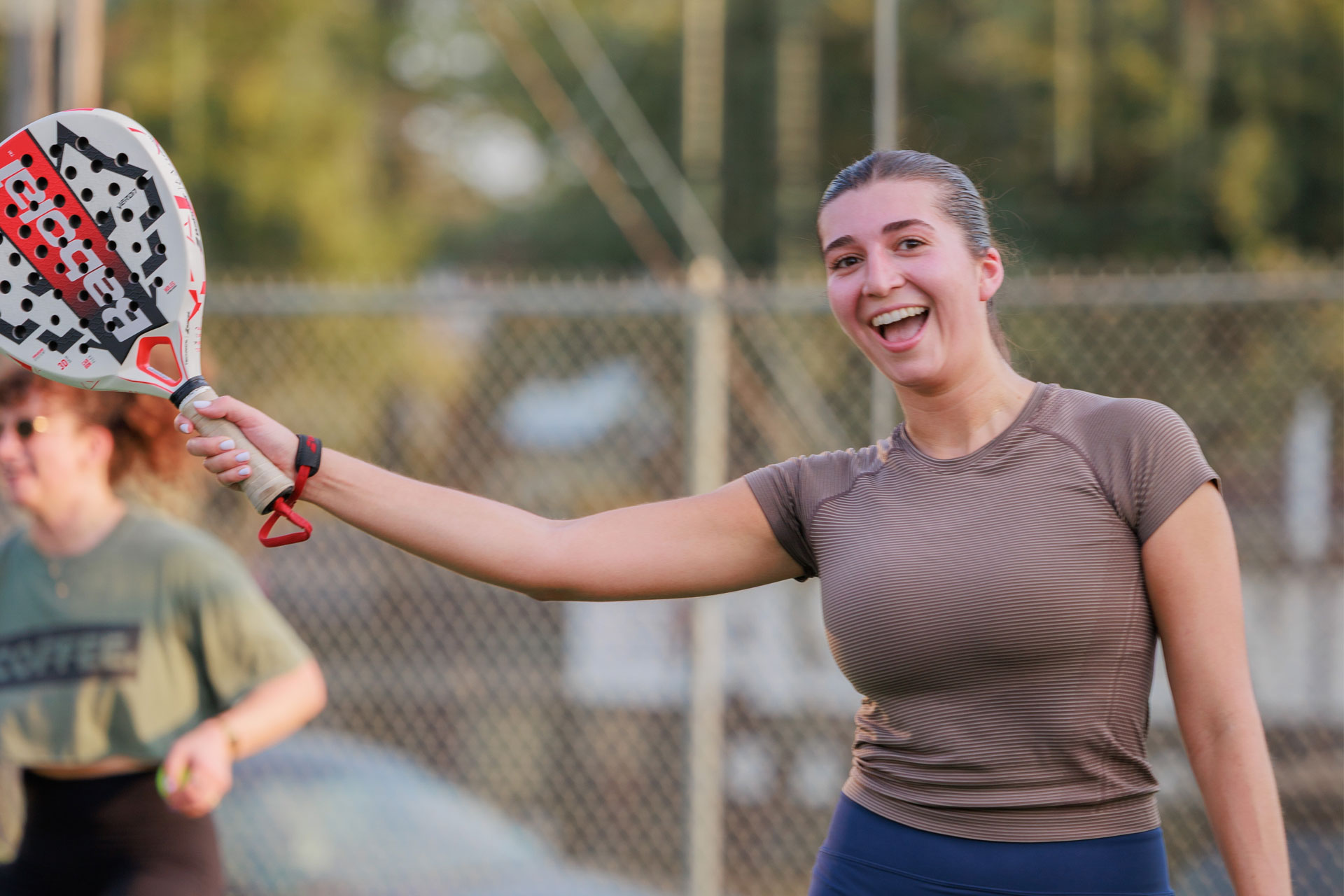
Padel and pickleball are both fast-growing racket sports that are easy to pick up and built for doubles. The big difference is the court. Padel is played inside glass walls that keep the ball in play, using a solid racket and a low-pressure tennis ball. Pickleball is played on an open court about the size of a badminton court, with a paddle and a perforated plastic ball. Padel plays more like tennis with squash-style rebounds; pickleball plays more like an oversized game of ping-pong.
If you're deciding between the two, or you're a pickleball player wondering what all the padel noise is about, this guide covers everything that actually matters.
Padel was invented in Mexico in 1969 and became a mainstream sport in Spain and Argentina before spreading across Europe and, more recently, the United States. It is played almost exclusively in doubles on an enclosed court with glass back walls and mesh sides.
The rules will feel familiar to anyone who has played tennis. Scoring is 15, 30, 40, game. Matches are best of three sets. The serve is underarm. The twist is the walls: after the ball bounces on the ground, it can rebound off the glass and still be in play, which turns a lot of would-be winners into long, tactical rallies.
Pickleball was invented on Bainbridge Island, Washington, in 1965. It's played on a 20 by 44 foot court, the same footprint as badminton doubles, with a low net, a paddle, and a hollow plastic ball with holes in it.
Games are usually played to 11 points, win by two. There is a seven-foot "kitchen" (non-volley zone) on each side of the net that you can't volley from, which keeps the game from becoming a smash-fest. Pickleball can be played singles or doubles, though doubles is far more common.
The wall is the whole story. On a pickleball court, a ball past you is a lost point. On a padel court, it comes back off the glass, so points last longer and positioning matters more than raw power.
Padel uses tennis scoring: points to 15, 30, 40, game; six games to a set; best of three sets. Some clubs and leagues use a "golden point" at deuce to keep matches moving. You serve underarm, at or below waist height, after bouncing the ball once. The ball can bounce on the floor and then hit any wall and still be live. If it hits a wall before the floor, it's out.
Pickleball uses its own system. Traditionally, only the serving side can score; games go to 11, and you have to win by two. The double-bounce rule means each side must let the ball bounce once before anyone can volley, and nobody can volley while standing in the kitchen.
If you already know tennis, padel's rulebook takes about five minutes. Pickleball's takes a little longer because the scoring and kitchen rules are unique to the sport.
Padel: a solid racket with no strings and holes through the face, roughly the size of a large ping-pong paddle, and a padel ball, which is a tennis ball with slightly lower pressure. Court shoes with good lateral grip. Most clubs, including ,, rent rackets so you can try before you buy.
Pickleball: a flat paddle, usually composite or graphite, and a plastic wiffle-style ball. Court shoes. Entry-level paddles are cheap; competitive ones can run well over $200.
Both get your heart rate up, but padel generally asks more of you. Rallies are longer, the court is bigger, and you're constantly moving between the net and the back glass. A competitive hour of padel is a proper cardio session with a lot of lateral movement.
Pickleball is lower impact and easier on the knees and shoulders, which is a big part of why it has been so popular with older players. That's a genuine advantage, not a knock.
If your goal is fitness, padel edges it. If your goal is a game you can play at 70, pickleball has a strong case, though plenty of padel players are proving it's a sport for life too.
Pickleball's biggest draw is that it is often free. Public courts are everywhere and many tennis courts have been re-lined for it. Buy a paddle and you're playing.
Padel needs a purpose-built court, so you'll be playing at a club. Court rental in Texas typically runs around $120 for a 90-minute court booking, split four ways (so about $30 a head), and most clubs offer memberships that bring the per-session cost down considerably. At Padel39, the cheapest way to try it is a free intro session, and the Player's Pass bundles your first clinic and open match.
Pickleball has the head start in the US by a wide margin, with roughly 23.4 million Americans playing. Padel is smaller but moving quickly: just over a million Americans played in 2025, and the country passed 1,000 courts across 31 states in April 2026, with Texas among the fastest-growing states.
Globally, the picture flips. Padel has an estimated 30 million players and is a top-three sport in Spain, with professional tours, Olympic ambitions, and clubs opening on every continent. Pickleball is still largely a North American phenomenon.
Choose padel if you want a sport with real tactical depth, you like longer rallies, you enjoy a club atmosphere with lessons, leagues and a social side, or you come from tennis or squash and want that feel without the learning curve.
Choose pickleball if you want something free and instant, you're looking for a lower-impact game, or you want to play singles as well as doubles.
Choose both if you're a racket sport person. The skills overlap more than you'd think, and a lot of Padel39 members play both.
Is padel harder than pickleball? Padel is harder to master but not harder to start. Most beginners are rallying within their first session. The walls add a layer of strategy that takes longer to learn, which is what keeps experienced players hooked.
Can pickleball players pick up padel quickly? Yes. The underarm serve, doubles positioning, and net play all transfer. The main adjustment is learning to let the ball come off the glass instead of chasing it.
Is padel the same as paddle tennis or platform tennis? No. Paddle tennis (POP tennis) is played on a smaller open court. Platform tennis is played on a raised, heated deck in cold climates. Padel is its own sport with glass walls and a turf surface.
Can you play padel in singles? Technically yes, on a narrower singles court, but they're rare. Padel is designed as a doubles game, and nearly every club runs doubles only.
Where can I play padel in Texas? Padel39 has clubs in North Austin, East Austin and North Dallas, all with weekly free intro sessions for first-timers.
Still curious? Book a free intro at any Padel39 club and find out for yourself which side you land on.